
The Evidence Gap
Trusting change before the world validates it

UNDER CALIBRATION — INTROSPECTION WITH ARCHITECTURE
Inner systems, dreams, and subconscious patterns
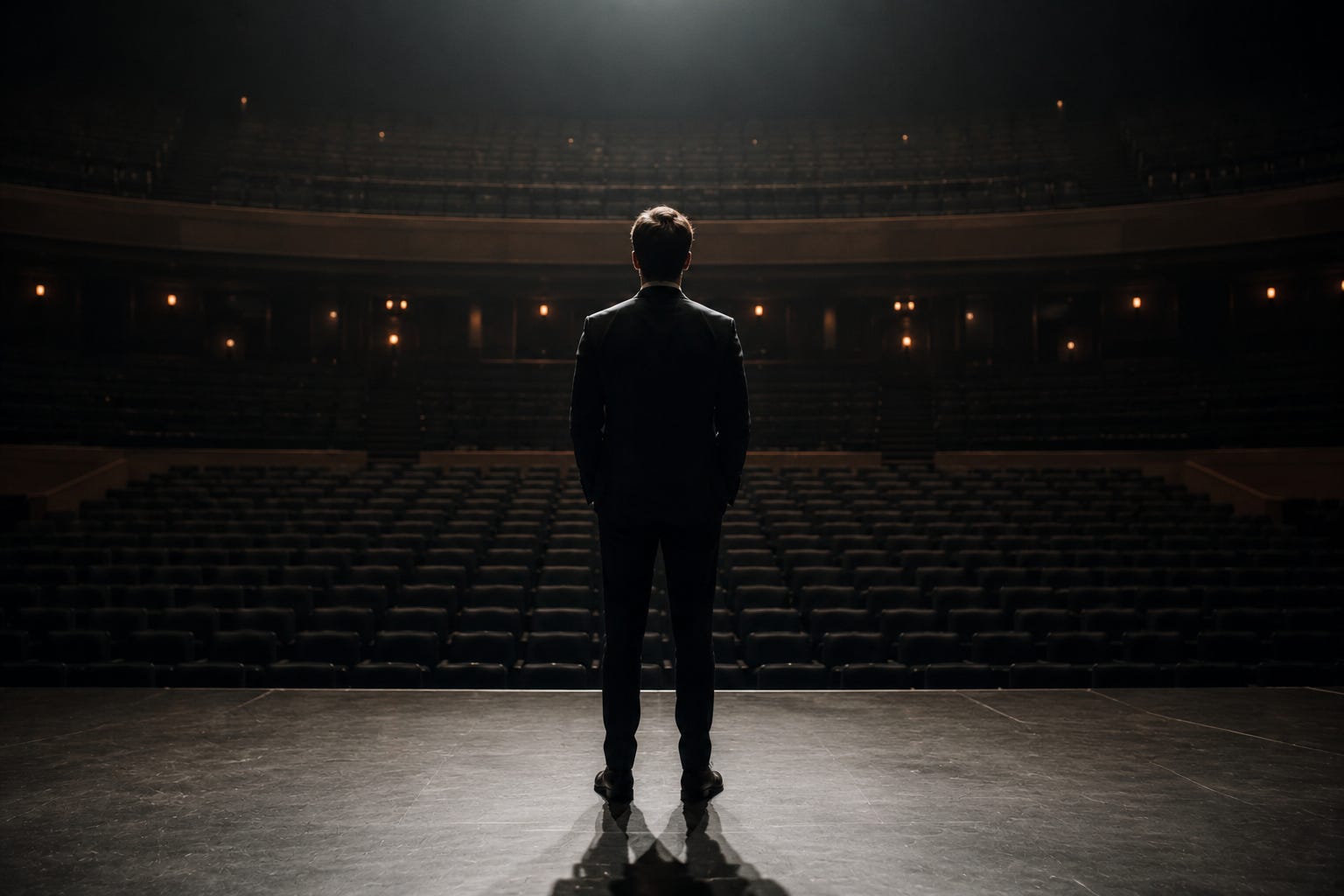
We’re taught to look outward for proof: outcomes, responses, numbers, visible progress. We trust what can be measured and verified but that also makes it easy to dismiss the earliest signs of change because they’re private.
Because external proof is almost always delayed.
The internal shift happens first.
You feel it before you can show it.
Sometimes it’s subtle: a conversation that no longer unsettles you, a decision that feels easier than it used to, a trigger that doesn’t pull the same reaction from you anymore. Sometimes nothing in your circumstances has changed at all but your relationship to those circumstances has. Your body feels different moving through the same life.
That matters more than we give it credit for.
The world is often the last thing to catch up.
Outcomes are lagging indicators. They can reflect change but they’re rarely the first evidence of it.
Before the promotion, there’s the way you carry yourself in the meeting.
Before the relationship changes, there’s the moment you stop abandoning yourself inside the conversation.
Before your life looks different, you do.
The hardest part is trusting that before anything visible confirms it.
Trusting the shift before the evidence.
Believing your experience before the results arrive.
Letting what you feel be enough, even while the world is still catching up.
Because change rarely announces itself all at once.
It begins quietly…inside your body, your choices, your way of moving through the same life.
And often, by the time the proof appears on the outside, you’ve already become someone new on the inside.
Two witnesses, Two speeds
Any real change in a person has two witnesses. The first is the world: other people, outcomes, numbers, the slow accumulation of consequences. This witness is public and we treat it as authoritative because it’s public.
What others can verify feels more real than what only we can feel. But the world is a slow witness. It reports late, in lagging indicators, and its testimony is badly contaminated by luck, timing and noise. The same internal change can produce a triumphant outcome one week and nothing the next, depending on circumstances that have nothing to do with you. To treat outcomes as the sole evidence of who you are becoming is not just emotionally precarious. It’s epistemically sloppy. You are deferring to your least reliable instrument.
The second witness is the body. This one is fast and private. It registers change as a leading indicator: a shift in baseline, a drop in resistance, a new ease where there used to be dread. The “evidence gap” is, in large part, simply the latency between these two witnesses: the body has already filed its report while the world is still gathering its facts.
Seen this way, embodiment isn’t a soft consolation for the impatient. It’s the discipline of learning to read the first witness and treating what you feel as data rather than as something you have to wait for the world to ratify before it counts.
The silent period
The body’s head start is not poetic; it’s physiological. Learning rewires you before it shows up in your performance.
Donald Hebb’s old principle, that neurons which fire together wire together, describes a process that is, for a while, entirely invisible from the outside. When you practice something or repeatedly choose a new response, synaptic connections strengthen through mechanisms like long-term potentiation. That structural change is laid down well before it expresses itself as fluent, automatic behavior. There is a real neurological lag between encoded and expressed. The day your new habit consolidates is not the day it becomes impressive to watch. So the faint sense that the second rep was a little less like dread than yesterday’s may be a more accurate readout of what’s actually consolidating than today’s clumsy, noise ridden performance.
Deeper still, contemporary neuroscience increasingly describes the brain as a prediction machine. In the predictive processing view developed by researchers like Karl Friston, Andy Clark, Anil Seth, and Lisa Feldman Barrett, much of what you experience is the brain’s model forecasting the world and your own body, then updating when reality disagrees. The most fundamental kind of personal change is a revision of these priors, quietly editing the prediction I am the sort of person who flinches at this, or who can’t, or who always. When that model updates, the update is felt as a shift in your baseline long before it manifests in action the world can see. The gap you’re living in is the model revising itself faster than the world can reflect the revision.
And you are equipped to detect this. Interoception, the sense of your own internal state, routed substantially through the insula, is a genuine sensory channel, as real as vision or hearing. Antonio Damasio’s somatic marker work suggests bodily states carry information that guides judgment, often ahead of conscious reasoning. The “gut feeling” that something has shifted is not noise to be overridden. It is sensory evidence of internal state. We’ve simply inherited a culture that doesn’t admit it. Embodiment, in practice, is following that.
Why outsourcing to outcomes backfires
If the body is reporting accurately, why do we keep waiting on the world anyway? Partly because the wiring that makes us feel progress is tuned to the external signal and tuning it more tightly is a trap.
Dopamine, in the work of researchers like Wolfram Schultz, tracks reward prediction error: the gap between what you expected and what arrived. Pleasure spikes most when a reward lands unexpectedly. If you let only outcomes confer the feeling of progress, you bind your motivation to a signal that is intermittent and controlled by forces outside you and intermittent reinforcement is the schedule that produces compulsive checking. Refreshing the inbox. Reweighing. Counting the likes. You train yourself into a contract where you are not allowed to feel you’re getting anywhere until an external event grants permission and then you are at the mercy of how often it does.
The psychologist Carl Rogers called this the locus of evaluation. When it sits inside you, you can assess your own movement and largely trust the assessment. When it migrates outward, when the verdict on your worth and progress always belongs to someone or something else, Rogers tied the result to anxiety and an erosion of self-trust. Outsourcing your sense of progress to outcomes is, in his terms, just the slow relocation of your focus of evaluation out of your own hands.
There’s a further cost. The overjustification effect, documented by researchers studying intrinsic motivation, shows that piling external rewards onto an activity can crowd out the internal motivation that was already there. If an outcome becomes the only reason a change counts, the quiet felt rightness that first moved you tends to wither. And outcomes make poor anchors for another reason still: hedonic adaptation. We habituate to results astonishingly fast. The number you hit, the title you wanted, the glow fades, the baseline resets, and you find yourself needing the next one. Define progress by outcomes and you are chasing a line that keeps receding. The felt sense of being someone different is, strangely, the more durable possession.
Practices for reading the first witness
These lean toward the unobvious, because the obvious ones, journaling wins, trusting the process, tend to keep your attention pointed at outcomes anyway.
1. Log sensations, not scores. Keep a record of the texture of change rather than its metrics. Not “ran 3 miles” but “the first mile stopped feeling like hard.” Sensation data is the body’s testimony in writing and writing it down is how you start treating it as admissible.
2. Locate the change in space. Vague change is easy to doubt. Ask where in your body you felt the shift, and be specific: my shoulders dropped when I declined. Spatial precision turns a mood into evidence you can return to.
3. Run the past self surprise test. Habituation hides your progress, what’s now automatic stops feeling notable. So don’t ask “did it work?” Ask: would the version of me from three months ago be startled that I just did that without thinking? This recovers change that has become invisible by becoming normal.
4. Count the nonevents. Some of the realest change leaves no trace by definition, the argument you didn’t start, the drink you didn’t pour, the spiral you stepped out of early. These produce zero external evidence precisely because they are absences. Train yourself to register the dog that didn’t bark.
5. Borrow the body’s faster clock. Before you check any external metric, take thirty seconds to scan inward and ask what has already shifted at the level of ease or effort. Consult the fast witness before the slow one, so the slow one doesn’t get the only word.
6. Schedule the outcome checking; keep the felt checking continuous. Looking at outcomes constantly amplifies noise and deepens dependence on them. Put external metrics on a schedule, weekly or monthly, and let interoceptive attention run free in between. You’ll measure less and notice more.
7. Write yourself a witness statement. Once in a while, testify. In your own first person words, state plainly what has changed in you, as if giving evidence and then treat your own account as legitimate. You are the only witness who was present for the internal part.
Under Calibration Takeaway
The “evidence gap” isn’t actually an absence of evidence… it’s a latency between two witnesses to any change. The world is the slow, public witness (lagging, noisy, contaminated by luck); the body is the fast, private one. Embodiment then becomes the discipline of learning to read that first witness instead of waiting for the world to ratify it.
Here is the reframe embodiment finally offers. The stretch between inner change and outer proof is not empty waiting. It is the felt sensation of a system mid revision, a prior being overwritten, a connection consolidating in the dark, a self model quietly editing its assumptions about what you are. The discomfort of the gap isn’t the absence of evidence. It is evidence: the particular ache of holding a new shape before the world has caught up to it.
The slow witness will arrive eventually. The numbers will move, the replies will come, someone will notice. But you don’t have to spend the interval as a stranger to your own change, hat in hand, waiting for permission to believe what your body has already filed under fact. Learn its language, and you discover the thing you thought you were missing was never missing at all. The first witness has been speaking to you the whole time… you just have to listen.
Under Calibration is a structured analysis of the subconscious, approached through architecture, not mysticism.
really captured that strange experience of internally feeling yourself change before your external life reflects it yet. There’s something very grounding about the idea that the body often recognizes growth long before the world does.✨
This is such a powerful distinction: the world is often treated as the final authority on our growth, when in reality it’s usually the last thing to notice it. Outcomes may be visible, but they are delayed. The body knows first.
What resonated most is the idea that the “evidence gap” isn’t a lack of progress… it’s the distance between internal transformation and external confirmation. Sometimes growth looks like less resistance, more peace, a softer reaction, a boundary that no longer feels impossible or a choice that suddenly feels natural. Those shifts may never make headlines but they’re often the most honest proof that change is already underway.
The version of you who once struggled with what now feels normal would recognize the transformation immediately. That’s why learning to trust the first witness… your own embodied experience… may be one of the deepest forms of self trust there is. The world will eventually catch up. The question is whether you’ll believe yourself before it does. This was beautifully written. 🌹