
The Greats.
On Imperfection & Legacy

CALIBRATED CHAOS — CORE EDITORIAL
Identity, ambition, and intentional living
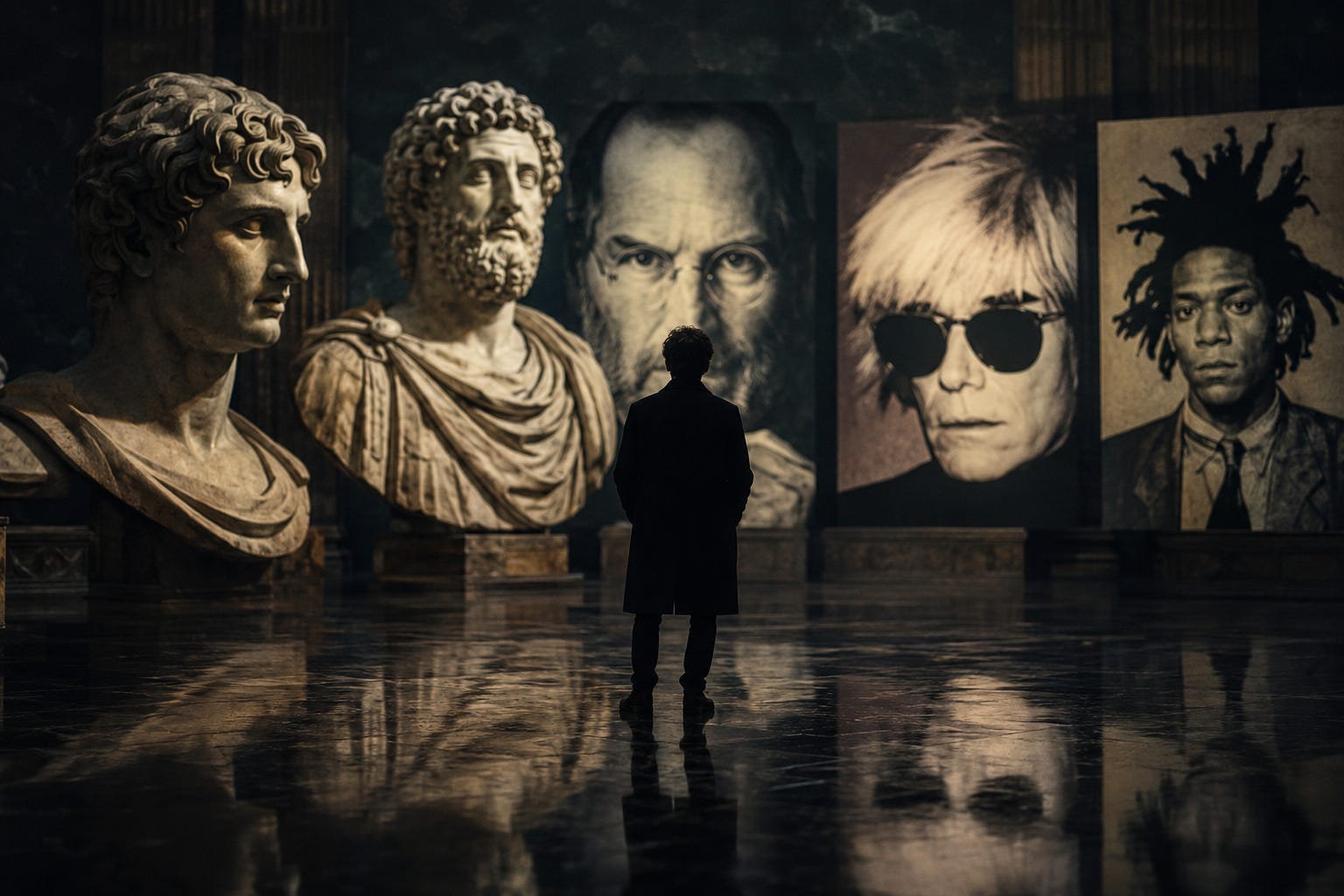
We have a habit of polishing the dead. We take their lives, sand off the rough edges, and present them to the world as monuments. We speak of their legacies as if they were immaculate, untouchable and impossibly human. We hang their names in museums, carve them into architecture and repeat their stories to our children as though they arrived in the world already complete. Yet, they were not.
Alexander the Great threw a spear through a friend in a drunken rage. Marcus Aurelius struggled daily against his own temper and admitted as much in private journals never meant to be read. Steve Jobs made people cry in elevators. Andy Warhol reduced human beings to aesthetic objects. Basquiat burned with a hunger so all consuming it eventually consumed him.
And yet, when we say their names today none of that is what comes to mind first.
This is not an apology for imperfection. It is a reminder that the people who changed the world were not especially virtuous…they were especially committed.
Commitment, not perfection, is the currency of legacy.
I. The Commanders
Alexander the Great
356 – 323 BC
By thirty, Alexander had conquered an empire stretching from Greece to the edges of India. He studied under Aristotle, memorized Homer and slept with a copy of the Iliad under his pillow. And then he went out and acted like Achilles, charging into battle at the front of his own cavalry, pushing his army across deserts and mountains that military theorists considered impassable.
He was also tyrannical, paranoid in his later years and responsible for atrocities he reportedly regretted. He killed one of his oldest friends in a fit of drunken fury. He died at thirty two having never stopped long enough to let his body recover from what he demanded of it.
History still calls him Great. Not in spite of the chaos but because of what emerged through it. He didn’t build a perfect empire. He built the largest one the ancient world had ever seen and in doing so spread Greek language, philosophy, and culture across a corridor of civilization that would echo for centuries. His flaws are footnotes… his vision is the headline.
The Lesson: Do not wait until you have eliminated the risk of error before you move. Move, and correct as you go.
Marcus Aurelius
121 – 180 AD
Marcus Aurelius governed the Roman Empire at its height for nearly two decades while managing plague, war, and the slow unraveling of a civilization. He did it as a man who never fully wanted the job and who was honest enough with himself to document every moment he fell short of his own standards.
His Meditations were never meant to be published. They were private notes, written on campaign to remind himself to be better because he knew he often wasn’t. He wasn’t a perfect Stoic. He was a man trying every day to live a philosophy he found genuinely difficult.
That honesty is what makes him singular. Not that he was great without struggle, but that he struggled so visibly and kept going anyway. Meditations has never gone out of print. Not because he was perfect…because he was honest about the work.
The Lesson: You don’t have to embody your values perfectly to build something worth keeping. You just have to keep reaching for them.
II. The Innovators
Steve Jobs
1955 – 2011
Steve Jobs was, by every reliable account, a genuinely difficult person to be around. He denied paternity of his daughter for years. He reduced engineers to tears in hallways. His co-founder Steve Wozniak is a warmer, more generous man.
Yet, Wozniak did not change the world the way Jobs did.
Jobs possessed something rarer than kindness. He had an almost violent intolerance for the gap between what existed and what was possible. He was fired from his own company, spent a decade wandering, built Pixar into a studio that reshaped animated storytelling. He then returned to Apple and created the iMac, the iPod, the iPhone, and the iPad. He didn’t come back humbled. He came back with the same ferocious clarity he’d always had.
We use his devices every day. Most people can’t name a single engineer who built them. They remember Jobs… because Jobs impact on modern innovation is undeniable.
The Lesson: The gap between vision and reality is crossed by relentlessness…not likability. Don’t let the world talk you into something smaller than what you’re building.
III. The Artists
Andy Warhol
1928 – 1987
Warhol was obsessive, remote, and deeply uncomfortable in his own skin. Critics spent his entire career asking whether he felt anything at all, whether there was a real artist behind the mirror he held up to culture. The accusation was an attempt to understand a man who was so enigmatic he couldn’t be contained.
Warhol understood something the art world wasn’t ready to admit: that commerce, celebrity, and mass reproduction weren’t the enemies of art. They were the new medium. The Factory was chaotic, drug addled, and occasionally dangerous. He was shot and nearly killed. His personal relationships were largely transactional. Yet, the work kept coming, paintings, films, books, a magazine because he treated his output the same way he treated everything else… more, always more and let the world decide what lasts.
It lasted. He didn’t just influence art. He predicted the internet, the selfie, the influencer and the brand as identity before any of it had a name. Modern pop culture, as we know it, is largely influenced by the his philosophy.
The Lesson: Prolific output committed to a clear vision will outlast brilliant work produced too sparingly. Show up and make the thing. Then, let the world do the curating.
Jean-Michel Basquiat
1960 – 1988
Basquiat arrived on the New York art scene as a teenager tagging subway cars under the name SAMO, short for Same Old Shit. By his mid twenties he was selling paintings for tens of thousands of dollars and by twenty-seven, he was dead.
In between, he made some of the most urgent work in postwar American art. His canvases were dense and contradictory: words, arrows, anatomical diagrams, crown symbols, references to Black history, jazz, boxing, and death. He wasn’t interested in being decorative….he was interested in being true.
He struggled with racism in an art world that found him exotic rather than essential, with an industry too enamored with his mystique to take his addiction seriously. He was exploited and isolated. But none of it diminished the work. It hangs in the world’s great museums now, still vibrating with the same voltage. Because Basquiat poured something original into it and originality has a way of being unignored.
The Lesson: When you make something genuinely, unapologetically yours, it cannot be replicated. Only recognized.
Perfection Was Never The Goal Post.
Not one person on this list was without serious flaw. Not one led a life you could hold up as a moral template without significant asterisks. They hurt people, made catastrophic errors, and had blind spots large enough to swallow careers, relationships, and decades. And yet here we are, still saying their names.
What they shared was not virtue…it was velocity. A forward momentum so singular and sustained that the world could not ignore what they were making, even when it very much wanted to. They were not waiting until they were ready. Not waiting until they had solved themselves. They were working! Imperfectly, stubbornly, sometimes through addiction or grief or failure and the work outlasted everything.
It will outlast you, too. If you make it.
CALIBRATED CHAOS TAKEAWAY:
Their mistakes are not the story. They are merely the friction that produces the story. They are evidence that you were actually moving, building and producing; oftentimes imperfectly, but still making your impact.
You will not be remembered for the days you almost quit, the arguments you lost, the drafts you burned or the versions of yourself you left behind. You will be remembered, if you are remembered, for what you kept building through all of it.
History doesn’t ask whether you were difficult. It asks whether what you made mattered. It asks whether you were honest, not about your flaws, but about your purpose.
Be honest about your purpose and relentless in its pursuit. And leave the perfection to people who aren’t trying to build anything.
The Greats certainly did.
Calibrated Chaos is a long form editorial on identity, recalibration, and the quiet work of becoming.
Wow! This is such a great piece. The exact reminder I needed, actually. Especially as I’ve been settling more into my voice and my boundaries. Sometimes I mess up. It’s so easy to hyper-focus on the parts of me that don’t feel “perfectly curated.” You forget, that’s not what makes a legacy.
This is an interesting take, and I don't disagree with it, but I'd like to at least offer another point of view. I don't think it is necessary to treat people horribly (Jobs) or feel the need to dehumanize (Warhol) in order to get your point across or do great work. Maybe that allowed them to make more breakthroughs, but is that really worth it at the end of the day, especially if the majority of these people ended up getting targeted/dying directly because of that stuff?